
Dog waste bags: background knowledge

It is estimated that over 4.4 billion dog waste bags are used in Germany every year1 – almost twice as many as lightweight plastic carrier bags (e.g. fruit and vegetable bags)2.


In this article, we provide comprehensive information about dog waste bags – why they are an important environmental issue, what opportunities and risks are associated with them, what materials are available on the market, what environmental impact they have and what solutions really make sense.

Why are dog waste bags an important environmental issue?

Mülleimer im Park; Hundekotbeutel – Hintergrundwissen, Materialien und Umweltauswirkungen
© mustafaoncul - adobe.stock.com

Littering: When dog waste bags become an environmental problem

Plastic shopping bags have been the focus of intense media attention for years. Measures have been taken to reduce the environmental impact caused by shopping bags. However, this is still largely not the case with dog waste bags. Unlike shopping bags, dog waste bags are increasingly used in natural areas. In many places, they end up in the environment.

The ‘Poop Bag Map’ we initiated in 2015 impressively showed how big the problem is: in Hamburg alone, over 5,000 locations were documented. Among the finds are often folded, unused bags that were obviously accidentally dropped in the environment (e.g. from a jacket pocket). In addition, many dog waste bags are unfortunately deliberately disposed of in the environment, mostly when full. However, unlike other types of litter, many dog owners still seem to be unaware of the problem posed by dog waste bags. Furthermore, studies show that littering is mainly determined by convenience, situational circumstances and cultural norms – not by material properties6.

In some hotspots, there are sometimes over 500 bags per kilometre of road. However, even with intensive efforts, only some of the bags can be collected. No city cleaning service or clean-up initiative can manage to remove all the bags from the environment. Apart from the high costs, for example for collection or cleaning in peripheral areas, it is often no longer possible to collect them. Many bags have already become deeply embedded in the ground or ended up in waterways. Moreover, the bags are often disposed of in bushes, where they are almost impossible to find.

Furthermore, the low material thickness accelerates fragmentation due to mechanical stress (e.g. wind). This makes the fragmented pieces even more difficult to be collected. When PE-based dog waste bags enter the environment, they can pose a major plastic waste problem for decades or even centuries; the resulting microplastics could be ingested by animals, harming them and/or entering the food chain.

Hundekotbeutel am Baum – Symbol für Littering; Hundekotbeutel – Hintergrundwissen, Materialien und Umweltauswirkungen
© Anders Haukland - stock.adobe.com

Two ways to solve the problem

Reduction of littering

Reduction of environmental impacts

Biodegradable dog waste bags – why are they needed and what should you look out for?

The best solution would be to stop dog waste bags from ending up in the natural environment. However, considering the extent of littering, this is highly unlikely. Education and optimised bin locations alone will not be sufficient. They cannot completely solve the problem.

Even biodegradable dog waste bags are not intended to be thrown into the environment. The enclosed dog waste and any pathogens they may contain are supposed to be removed from the environment.

But: in the context of the littering problem, dog waste bags can serve as an airbag if they are biodegradable at low temperatures at a significant rate.

Some biodegradable materials require temperatures of around 60 °C to degrade. Consequently, the process is just as ineffective at low temperatures as it is with PE. For example, this can be the case with products/materials that are only certified according to the European standard DIN EN 13432 (‘OK compost INDUSTRIAL’). The following certifications, on the other hand, are very good indicators of biodegradability at low temperatures:

In addition, there are significant differences in the degradation rate of certified bioplastics. In various tests we conducted in nature, we found that some products were still intact after a year. They only had small holes. By comparison, our biodegradable dog waste bags were almost completely degraded after approximately 12 weeks in one of our tests.

When biodegradable dog waste bags are disposed of correctly in residual waste, they also have an advantage over conventional plastic bags in terms of thermal recovery. The renewable components of the material release only as much CO₂ as was absorbed during the growth phase. Compared to PE bags made from new granulate, this results in significant CO₂ savings.

Further information can be found on the pages ‘Standards and Certificates’, ‘Biodegradability‘ and ‘FAQ’.

What materials are used for dog waste bags and what impact do they have on the environment?

Regardless of the littering issue, it is always important to take a close look at the materials used in a provider’s dog waste bags. This can make a big difference from an environmental perspective.

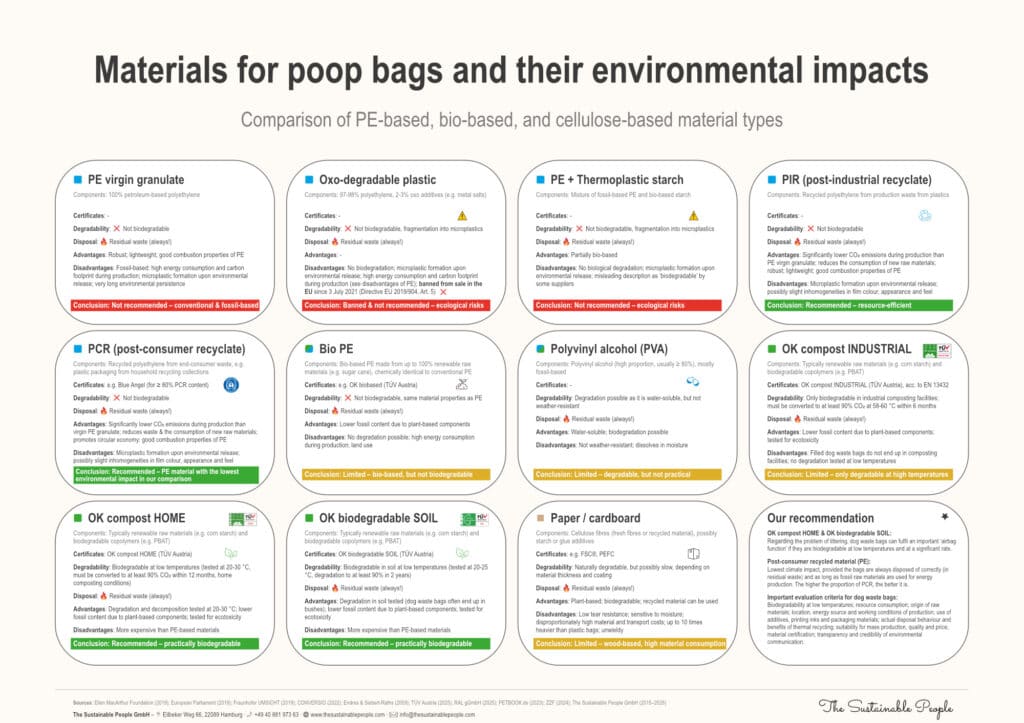
Therefore, to provide guidance to consumers, businesses and local authorities, we have developed a poster that clearly illustrates the different types of dog waste bags – from PE-based to bio-based and paper-based variants. It also shows the environmental impact of each option and how they differ from one another:

The best choice

The choice of material should always be made in the context of the evaluation criteria listed on the poster.

Conclusion

Dog waste bags are a small product with a big environmental impact. They are an example of how technological innovation and individual responsibility must work together to achieve true sustainability. By using eco-friendly designed dog waste bags, disposing of them correctly and raising awareness among others, you can make a direct contribution to cleaner cities and a better ecological footprint.

Ultimately, no matter what material the bag is made of, proper disposal is crucial. Dog waste bags always belong in the residual waste bin, never in the organic waste bin or in the environment.

In short, dog waste bags made from certified recycled or biodegradable materials offer the opportunity to reduce the environmental impact of plastic without sacrificing hygiene and convenience. For years, we have been committed to creating the most eco-friendly solutions possible through innovation, transparent communication and education – for a clean environment and responsible behaviour in everyday life.

Find out more on these pages: ‘Standards and Certificates’, ‘Biodegradability‘, ‘Recyclate‘, ‘Microplastic‘ and ‘FAQ’.

Sources & Further Information

1. Own calculation, The Sustainable People GmbH (2025), data basis: 10.5 million dogs in Germany (ZZF – Pets in Germany), average consumption of 2.1 dog waste bags per day (own Instagram survey), results of the Petbook survey “Do you really always pick up dog waste?”

2. Eurostat (2023): Consumption of lightweight plastic carrier bags by their wall thickness

3. Hinney, B. et al. (2017): Prevalence of endoparasites in canine faecal samples, Veterinary Parasitology, Volume 245, Pages 106–115

4. Own survey of German cities & own market observation, The Sustainable People GmbH (2015–2025)

5. Poop Bag Map & own data collections, The Sustainable People GmbH (2015–2025)

6. Hanson, P.-A. et al. (2025): “Do Biodegradable Plastics Encourage Littering? A Critical Review”, Alder BioInsights (NNFCC Ltd Company) & BBIA

Dog waste bags: background knowledge

It is estimated that over 4.4 billion dog waste bags are used in Germany every year1 – almost twice as many as lightweight plastic carrier bags (e.g. fruit and vegetable bags)2.

In this article, we provide comprehensive information about dog waste bags – why they are an important environmental issue, what opportunities and risks are associated with them, what materials are available on the market, what environmental impact they have and what solutions really make sense.

Dog waste bags: background knowledge

It is estimated that over 4.4 billion dog waste bags are used in Germany every year1 – almost twice as many as lightweight plastic carrier bags (e.g. fruit and vegetable bags)2.

In this article, we provide comprehensive information about dog waste bags – why they are an important environmental issue, what opportunities and risks are associated with them, what materials are available on the market, what environmental impact they have and what solutions really make sense.

Why are dog waste bags an important environmental issue?

Mülleimer im Park; Hundekotbeutel – Hintergrundwissen, Materialien und Umweltauswirkungen
© mustafaoncul - adobe.stock.com

Why are dog waste bags an important environmental issue?

Littering: When dog waste bags become an environmental problem

Plastic shopping bags have been the focus of intense media attention for years. Measures have been taken to reduce the environmental impact caused by shopping bags. However, this is still largely not the case with dog waste bags. Unlike shopping bags, dog waste bags are increasingly used in natural areas. In many places, they end up in the environment.

The ‘Poop Bag Map’ we initiated in 2015 impressively showed how big the problem is: in Hamburg alone, over 5,000 locations were documented. Among the finds are often folded, unused bags that were obviously accidentally dropped in the environment (e.g. from a jacket pocket). In addition, many dog waste bags are unfortunately deliberately disposed of in the environment, mostly when full. However, unlike other types of litter, many dog owners still seem to be unaware of the problem posed by dog waste bags. Furthermore, studies show that littering is mainly determined by convenience, situational circumstances and cultural norms – not by material properties6.

In some hotspots, there are sometimes over 500 bags per kilometre of road. However, even with intensive efforts, only some of the bags can be collected. No city cleaning service or clean-up initiative can manage to remove all the bags from the environment. Apart from the high costs, for example for collection or cleaning in peripheral areas, it is often no longer possible to collect them. Many bags have already become deeply embedded in the ground or ended up in waterways. Moreover, the bags are often disposed of in bushes, where they are almost impossible to find.

Furthermore, the low material thickness accelerates fragmentation due to mechanical stress (e.g. wind). This makes the fragmented pieces even more difficult to be collected. When PE-based dog waste bags enter the environment, they can pose a major plastic waste problem for decades or even centuries; the resulting microplastics could be ingested by animals, harming them and/or entering the food chain.

Hundekotbeutel am Baum – Symbol für Littering; Hundekotbeutel – Hintergrundwissen, Materialien und Umweltauswirkungen
© Anders Haukland - stock.adobe.com

Littering: When dog waste bags become an environmental problem

Plastic shopping bags have been the focus of intense media attention for years. Measures have been taken to reduce the environmental impact caused by shopping bags. However, this is still largely not the case with dog waste bags. Unlike shopping bags, dog waste bags are increasingly used in natural areas. In many places, they end up in the environment.

The ‘Poop Bag Map’ we initiated in 2015 impressively showed how big the problem is: in Hamburg alone, over 5,000 locations were documented. Among the finds are often folded, unused bags that were obviously accidentally dropped in the environment (e.g. from a jacket pocket). In addition, many dog waste bags are unfortunately deliberately disposed of in the environment, mostly when full. However, unlike other types of litter, many dog owners still seem to be unaware of the problem posed by dog waste bags. Furthermore, studies show that littering is mainly determined by convenience, situational circumstances and cultural norms – not by material properties6.

In some hotspots, there are sometimes over 500 bags per kilometre of road. However, even with intensive efforts, only some of the bags can be collected. No city cleaning service or clean-up initiative can manage to remove all the bags from the environment. Apart from the high costs, for example for collection or cleaning in peripheral areas, it is often no longer possible to collect them. Many bags have already become deeply embedded in the ground or ended up in waterways. Moreover, the bags are often disposed of in bushes, where they are almost impossible to find.

Furthermore, the low material thickness accelerates fragmentation due to mechanical stress (e.g. wind). This makes the fragmented pieces even more difficult to be collected. When PE-based dog waste bags enter the environment, they can pose a major plastic waste problem for decades or even centuries; the resulting microplastics could be ingested by animals, harming them and/or entering the food chain.

Hundekotbeutel am Baum – Symbol für Littering; Hundekotbeutel – Hintergrundwissen, Materialien und Umweltauswirkungen
© Anders Haukland - stock.adobe.com

Two ways to solve the problem

Reduction of littering

Reduction of environmental impacts

Biodegradable dog waste bags – why are they needed and what should you look out for?

The best solution would be to stop dog waste bags from ending up in the natural environment. However, considering the extent of littering, this is highly unlikely. Education and optimised bin locations alone will not be sufficient. They cannot completely solve the problem.

Even biodegradable dog waste bags are not intended to be thrown into the environment. The enclosed dog waste and any pathogens they may contain are supposed to be removed from the environment.

But: in the context of the littering problem, dog waste bags can serve as an airbag if they are biodegradable at low temperatures at a significant rate.

Some biodegradable materials require temperatures of around 60 °C to degrade. Consequently, the process is just as ineffective at low temperatures as it is with PE. For example, this can be the case with products/materials that are only certified according to the European standard DIN EN 13432 (‘OK compost INDUSTRIAL’). The following certifications, on the other hand, are very good indicators of biodegradability at low temperatures:

In addition, there are significant differences in the degradation rate of certified bioplastics. In various tests we conducted in nature, we found that some products were still intact after a year. They only had small holes. By comparison, our biodegradable dog waste bags were almost completely degraded after approximately 12 weeks in one of our tests.

When biodegradable dog waste bags are disposed of correctly in residual waste, they also have an advantage over conventional plastic bags in terms of thermal recovery. The renewable components of the material release only as much CO₂ as was absorbed during the growth phase. Compared to PE bags made from new granulate, this results in significant CO₂ savings.

Further information can be found on the pages ‘Standards and Certificates’, ‘Biodegradability‘ and ‘FAQ’.

Biodegradable dog waste bags – why are they needed and what should you look out for?

The best solution would be to stop dog waste bags from ending up in the natural environment. However, considering the extent of littering, this is highly unlikely. Education and optimised bin locations alone will not be sufficient. They cannot completely solve the problem.

Even biodegradable dog waste bags are not intended to be thrown into the environment. The enclosed dog waste and any pathogens they may contain are supposed to be removed from the environment.

But: in the context of the littering problem, dog waste bags can serve as an airbag if they are biodegradable at low temperatures at a significant rate.

Some biodegradable materials require temperatures of around 60 °C to degrade. Consequently, the process is just as ineffective at low temperatures as it is with PE. For example, this can be the case with products/materials that are only certified according to the European standard DIN EN 13432 (‘OK compost INDUSTRIAL’). The following certifications, on the other hand, are very good indicators of biodegradability at low temperatures:

In addition, there are significant differences in the degradation rate of certified bioplastics. In various tests we conducted in nature, we found that some products were still intact after a year. They only had small holes. By comparison, our biodegradable dog waste bags were almost completely degraded after approximately 12 weeks in one of our tests.

When biodegradable dog waste bags are disposed of correctly in residual waste, they also have an advantage over conventional plastic bags in terms of thermal recovery. The renewable components of the material release only as much CO₂ as was absorbed during the growth phase. Compared to PE bags made from new granulate, this results in significant CO₂ savings.

Further information can be found on the pages ‘Standards and Certificates’, ‘Biodegradability‘ and ‘FAQ’.

What materials are used for dog waste bags and what impact do they have on the environment?

Regardless of the littering issue, it is always important to take a close look at the materials used in a provider’s dog waste bags. This can make a big difference from an environmental perspective.

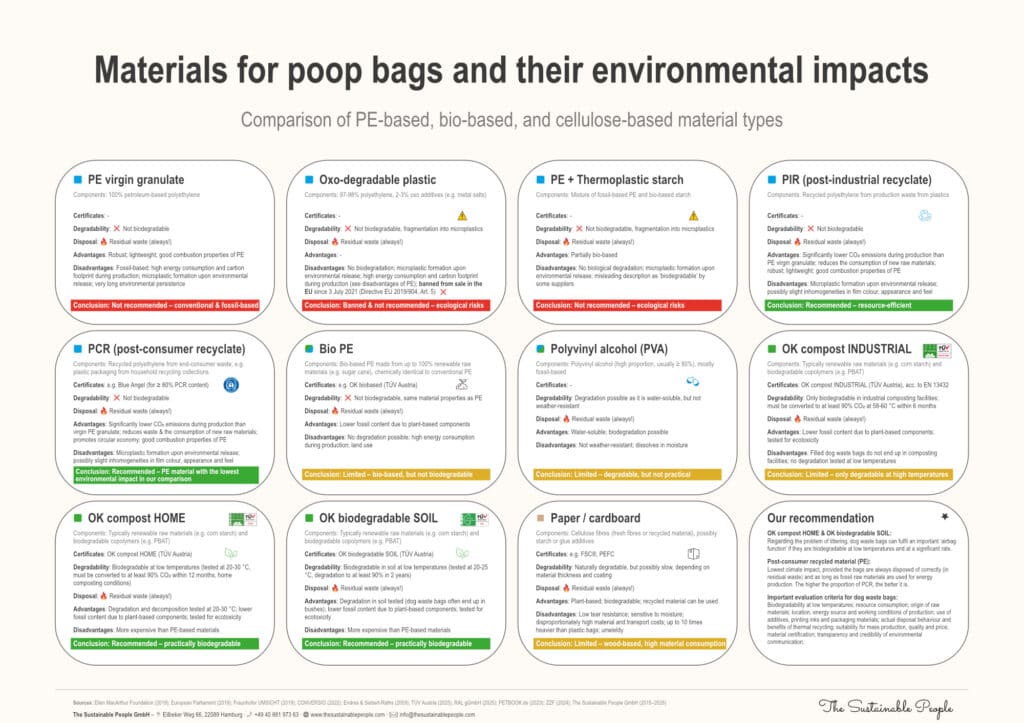
Therefore, to provide guidance to consumers, businesses and local authorities, we have developed a poster that clearly illustrates the different types of dog waste bags – from PE-based to bio-based and paper-based variants. It also shows the environmental impact of each option and how they differ from one another:

What materials are used for dog waste bags and what impact do they have on the environment?

Regardless of the littering issue, it is always important to take a close look at the materials used in a provider’s dog waste bags. This can make a big difference from an environmental perspective.

Therefore, to provide guidance to consumers, businesses and local authorities, we have developed a poster that clearly illustrates the different types of dog waste bags – from PE-based to bio-based and paper-based variants. It also shows the environmental impact of each option and how they differ from one another:

The best choice

The choice of material should always be made in the context of the evaluation criteria listed on the poster.

The best choice

The choice of material should always be made in the context of the evaluation criteria listed on the poster.

Conclusion

Dog waste bags are a small product with a big environmental impact. They are an example of how technological innovation and individual responsibility must work together to achieve true sustainability. By using eco-friendly designed dog waste bags, disposing of them correctly and raising awareness among others, you can make a direct contribution to cleaner cities and a better ecological footprint.

Ultimately, no matter what material the bag is made of, proper disposal is crucial. Dog waste bags always belong in the residual waste bin, never in the organic waste bin or in the environment.

In short, dog waste bags made from certified recycled or biodegradable materials offer the opportunity to reduce the environmental impact of plastic without sacrificing hygiene and convenience. For years, we have been committed to creating the most eco-friendly solutions possible through innovation, transparent communication and education – for a clean environment and responsible behaviour in everyday life.

Find out more on these pages: ‘Standards and Certificates’, ‘Biodegradability‘, ‘Recyclate‘, ‘Microplastic‘ and ‘FAQ’.

Sources & Further Information

1. Own calculation, The Sustainable People GmbH (2025), data basis: 10.5 million dogs in Germany (ZZF – Pets in Germany), average consumption of 2.1 dog waste bags per day (own Instagram survey), results of the Petbook survey “Do you really always pick up dog waste?”

2. Eurostat (2023): Consumption of lightweight plastic carrier bags by their wall thickness

3. Hinney, B. et al. (2017): Prevalence of endoparasites in canine faecal samples, Veterinary Parasitology, Volume 245, Pages 106–115

4. Own survey of German cities & own market observation, The Sustainable People GmbH (2015–2025)

5. Poop Bag Map & own data collections, The Sustainable People GmbH (2015–2025)

6. Hanson, P.-A. et al. (2025): “Do Biodegradable Plastics Encourage Littering? A Critical Review”, Alder BioInsights (NNFCC Ltd Company) & BBIA

Conclusion

Dog waste bags are a small product with a big environmental impact. They are an example of how technological innovation and individual responsibility must work together to achieve true sustainability. By using eco-friendly designed dog waste bags, disposing of them correctly and raising awareness among others, you can make a direct contribution to cleaner cities and a better ecological footprint.

Ultimately, no matter what material the bag is made of, proper disposal is crucial. Dog waste bags always belong in the residual waste bin, never in the organic waste bin or in the environment.

In short, dog waste bags made from certified recycled or biodegradable materials offer the opportunity to reduce the environmental impact of plastic without sacrificing hygiene and convenience. For years, we have been committed to creating the most eco-friendly solutions possible through innovation, transparent communication and education – for a clean environment and responsible behaviour in everyday life.

Find out more on these pages: ‘Standards and Certificates’, ‘Biodegradability‘, ‘Recyclate‘, ‘Microplastic‘ and ‘FAQ’.

Sources & Further Information

1. Own calculation, The Sustainable People GmbH (2025), data basis: 10.5 million dogs in Germany (ZZF – Pets in Germany), average consumption of 2.1 dog waste bags per day (own Instagram survey), results of the Petbook survey “Do you really always pick up dog waste?”

2. Eurostat (2023): Consumption of lightweight plastic carrier bags by their wall thickness

3. Hinney, B. et al. (2017): Prevalence of endoparasites in canine faecal samples, Veterinary Parasitology, Volume 245, Pages 106–115

4. Own survey of German cities & own market observation, The Sustainable People GmbH (2015–2025)

5. Poop Bag Map & own data collections, The Sustainable People GmbH (2015–2025)

6. Hanson, P.-A. et al. (2025): “Do Biodegradable Plastics Encourage Littering? A Critical Review”, Alder BioInsights (NNFCC Ltd Company) & BBIA

Logo_3zeilig_beige

CONTACT

The Sustainable People
Eilbeker Weg 66
22089 Hamburg
+49 (0)40 – 881 973 63
info@thesustainablepeople.com

© The Sustainable People – All rights reserved.